What Is ISO Certification, and Why Does It Matter for Noida Businesses?
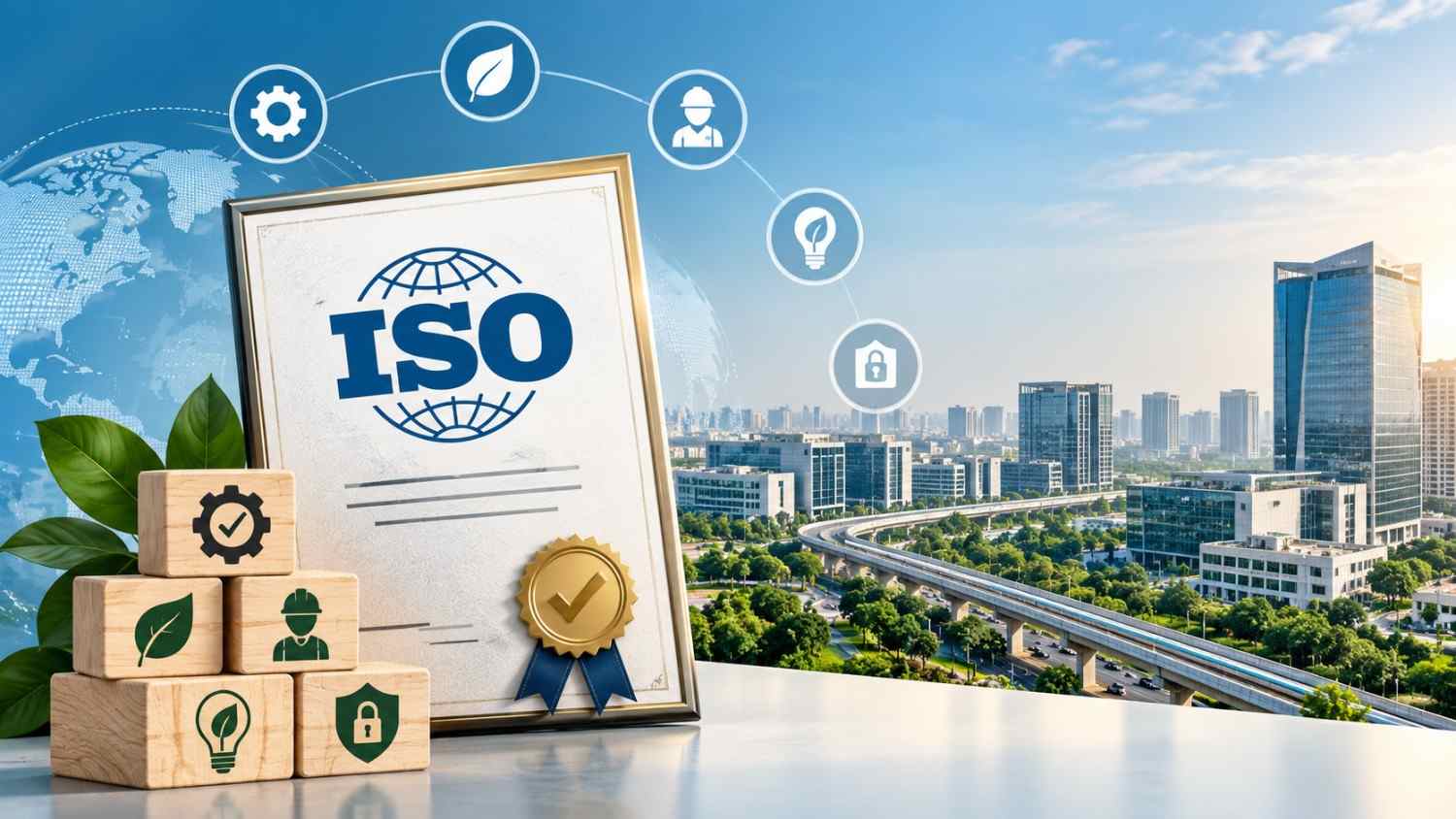
ISO stands for the International Organization for Standardization. ISO certifications are internationally recognized standards that verify a business meets specific requirements — for quality, safety, environmental management, energy use, or other operational areas.
Here is the practical part: most large buyers, government tenders, and export contracts now require suppliers to hold relevant ISO certifications. Without one, you are automatically excluded from a growing portion of available work.
Noida's industrial base — spanning sectors like electronics manufacturing, textiles, pharmaceuticals, and IT services — is increasingly integrated with global supply chains. International buyers require proof of compliance before signing contracts. ISO certification is that proof.
Beyond contracts, ISO certification forces a company to build consistent, documented processes. That reduces errors, lowers operational costs, and makes it far easier to train new employees. The certification is visible to clients. The internal improvements are felt every day.
Which ISO Standard Does Your Noida Business Need?
There are over 20 ISO standards in active use across Indian industries. Most businesses in Noida need one of five.
ISO 9001 — Quality Management System
This is the most widely held ISO certification in the world. ISO 9001 applies to any business that wants to demonstrate consistent quality in its products or services. It is required by most large buyers and government procurement bodies. If you are unsure which standard to start with, start here.
ISO 14001 — Environmental Management System
ISO 14001 applies to businesses with a measurable environmental footprint — manufacturing, chemicals, textiles, construction, and similar sectors. It is increasingly required by export buyers and multinational supply chains. It also demonstrates compliance with India's environmental regulations.
ISO 45001 — Occupational Health and Safety
ISO 45001 covers workplace health and safety management. Factories, warehouses, and any business with physical operational risks need this standard. It reduces workplace incidents, lowers insurance costs, and is required by many export buyers.
ISO 50001 — Energy Management System
ISO 50001 applies to energy-intensive businesses. It provides a framework for reducing energy consumption and costs. It is relevant for manufacturers, large commercial facilities, and any business trying to reduce its carbon footprint.
ISO 27001 — Information Security Management System
ISO 27001 applies to IT companies, data processors, and any business handling sensitive client information. It is becoming a standard requirement in IT contracts across India and internationally.
Most businesses in Noida start with ISO 9001, then add ISO 14001 or ISO 45001 as their client requirements expand. Some pursue an Integrated Management System — combining two or three standards into one unified framework — to reduce audit duplication and documentation costs.
What Is the ISO Certification Process in Noida?
The process has six stages. Each stage builds on the last.
Stage 1: Gap Analysis
A consultant or internal team assesses your current operations against the requirements of the target ISO standard. This identifies what is already in place and what needs to be built or documented. A detailed gap analysis prevents surprises during the final audit.
Stage 2: Planning and Documentation
You develop the policies, procedures, and records the standard requires. For ISO 9001, this includes a quality manual, process documentation, and defined responsibilities. For ISO 14001, it includes an environmental aspects register and legal compliance tracking.
Stage 3: Implementation
Your team begins operating according to the new documented procedures. This stage is where most of the real work happens — training staff, adjusting workflows, and building the habits that will sustain the system long-term.
Stage 4: Internal Audit
Before the external audit, you conduct an internal audit to check that the system is working as documented. Internal audits surface non-conformities early, so they can be corrected before the certification body arrives.
Stage 5: Management Review
Senior leadership reviews the performance of the management system. This step is required by all ISO standards. It ensures leadership is engaged and that the system is improving over time.
Stage 6: External Certification Audit
A NABCB-accredited certification body conducts a two-stage external audit. Stage 1 is a document review. Stage 2 is an on-site assessment of your operations. If the auditor finds no major non-conformities, your business is awarded ISO certification.
The certificate is valid for three years. Surveillance audits are conducted annually to maintain it.
How Long Does ISO Certification Take in Noida?
For most businesses, ISO certification takes 3 to 6 months from the start of the gap analysis to the final certification audit.
The timeline depends on three factors. First, your current level of documentation and process maturity. A business with no formal procedures takes longer than one that already has documented workflows. Second, the size and complexity of your operations. A 10-person MSME moves faster than a 200-person manufacturer. Third, how quickly your team implements changes.
Working with an experienced consulting firm — one that provides documentation templates, pre-audit training, and structured project management — cuts the timeline significantly. DLV ESG Consulting Services, for example, structures the process to avoid the back-and-forth that slows down self-managed certifications.
What Does ISO Certification Cost in Noida?
ISO certification costs vary. There are two separate components: consulting fees and certification body fees.
Consulting fees cover gap analysis, documentation support, implementation guidance, and internal audit training. These vary depending on the scope of work, the number of standards being pursued, and the size of your organization.
Certification body fees cover the external audit conducted by an accredited certification body. These fees depend on the number of audit days required, which is determined by your employee count and operational complexity.
For a small to mid-size business in Noida pursuing ISO 9001, the total cost — consulting plus certification — typically falls in the range of ₹50,000 to ₹1,50,000. Larger manufacturers or businesses pursuing multiple standards will pay more.
The right way to evaluate this cost: compare it against the value of the contracts that require ISO certification as a prerequisite. For most businesses, a single new contract recovered pays for the certification many times over.
Common Mistakes That Delay ISO Certification
Most businesses that struggle with ISO certification make the same few mistakes.
Treating it as a documentation exercise. ISO certification requires real changes to how your business operates. Businesses that only create documents — without implementing what those documents describe — fail their audits.
Underestimating internal resource requirements. Someone inside your organization needs to own the process. Without a dedicated internal owner, implementation stalls.
Choosing an uncredited certification body. ISO certificates issued by non-NABCB-accredited bodies are not recognized by most large buyers. Always confirm that your certification body holds valid NABCB accreditation.
Skipping internal audits. Businesses that skip internal audits arrive at their external audit unprepared. Non-conformities that could have been corrected in advance are instead discovered by the external auditor.
Starting without a gap analysis. Without a clear baseline, businesses spend time and money working on areas that are already compliant while missing the areas that actually need work.
Why Businesses in Noida Choose DLV ESG Consulting Services
DLV ESG Consulting Services is a Gurgaon-based consulting firm with direct experience supporting businesses across the NCR region — including Noida — through ISO certification. The firm has helped over 500 businesses achieve certification across 15+ ISO standards, following a NABCB-compliant process.
For businesses pursuing ISO certification in Noida, DLV ESG Consulting Services provides:
- Gap analysis — a clear assessment of where you stand before any work begins
- Documentation support — templates and structured frameworks for all required policies and procedures
- Implementation guidance — practical support for training your team and embedding the system into daily operations
- Pre-audit preparation — internal audit facilitation and management review support
- Certification audit coordination — liaison with accredited certification bodies to schedule and manage the external audit
The average certification timeline with DLV ESG Consulting Services is 3 to 6 months. The process is structured to minimize disruption to your operations.
DLV ESG Consulting Services also supports businesses that need to combine ISO certification with ESG compliance, BRSR reporting, or social and labour compliance audits such as SA 8000 and SMETA — a common requirement for export-oriented units in Noida.
Contact DLV ESG Consulting Services:
Start Your ISO Certification in Noida
ISO certification is not a box-ticking exercise. It is a structured way to build the systems your business needs to compete — and to prove to buyers, clients, and regulators that you operate to an internationally recognized standard.
Businesses in Noida that hold ISO certification win more tenders, qualify for more export contracts, and operate more consistently than those that don't. The process takes 3 to 6 months. The results last years.
The first step is a gap analysis — a clear picture of where your business stands today. DLV ESG Consulting Services offers a free initial consultation to help you identify which standard applies, what the process will look like for your specific business, and what the investment will be.
Reach out to DLV ESG Consulting Services at +91 97174 90156 or info@dlvesg.com to get started.