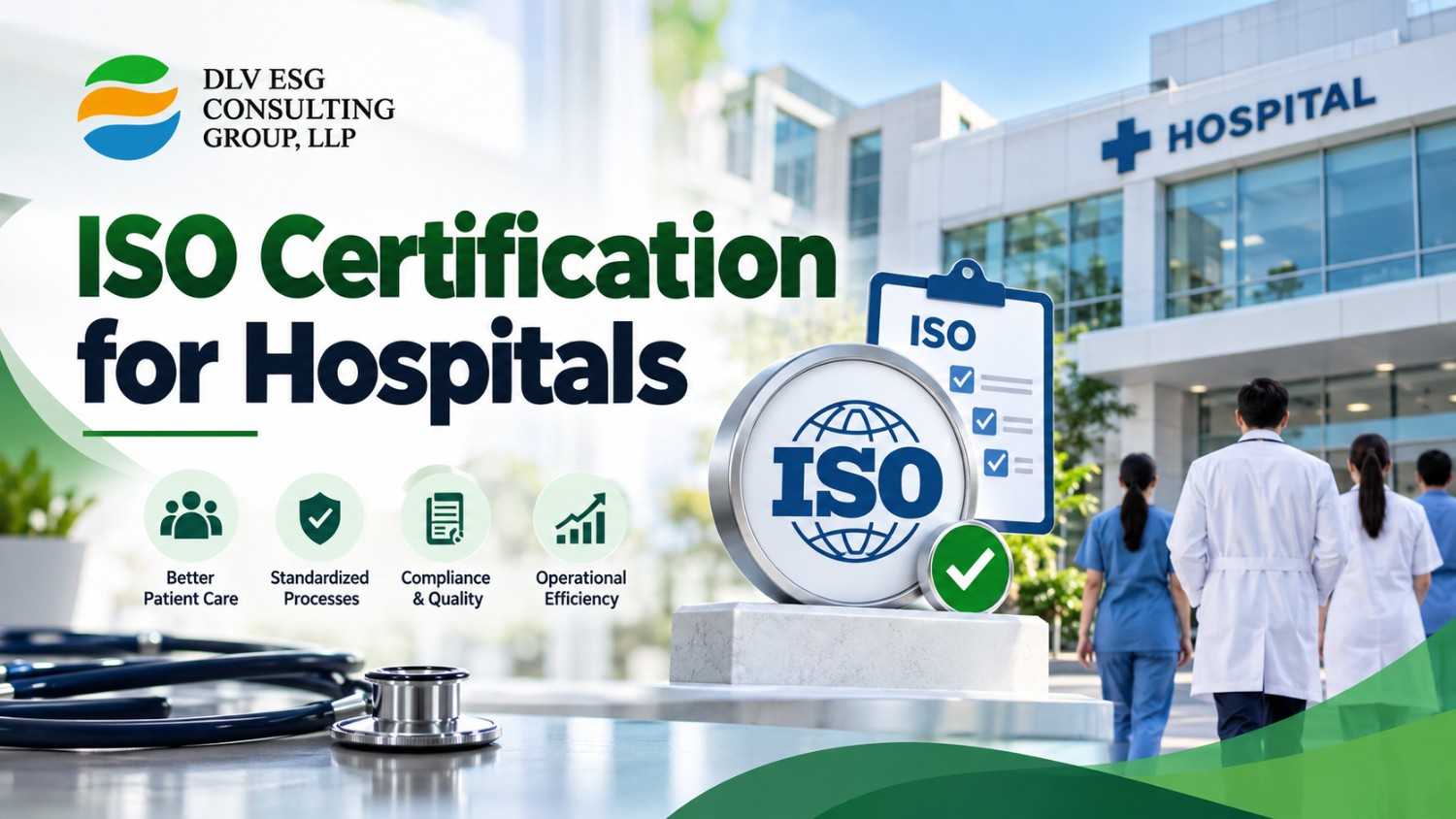
ISO Certification for Hospitals: Complete Guide to Quality, Compliance & Patient-Centric Healthcare

Learn about ISO certification for hospitals, ISO 9001, ISO 7101, benefits, process, FAQs, case studies, and DLV consulting support.

Introduction

Healthcare organizations operate in an environment where quality, patient safety, documentation, regulatory compliance, and continual improvement are extremely important. A hospital may have highly qualified doctors and modern medical equipment, but without standardized processes, consistent service delivery can become difficult to maintain.

ISO certification for hospitals provides a structured approach to developing, implementing, monitoring, and continually improving management systems across healthcare operations. Depending on the hospital's requirements, different ISO standards may be relevant, including ISO 9001 for quality management, ISO 7101 for healthcare organizations, ISO 14001 for environmental management, ISO 45001 for occupational health and safety, ISO 22000 for food safety, and ISO 15189 for medical laboratories.

As healthcare becomes increasingly process-driven and data-driven, hospitals are looking beyond basic compliance. They are focusing on patient experience, risk management, infection control, operational efficiency, documentation, staff competency, and measurable quality objectives.

This guide explains ISO certification for hospitals, the applicable standards, certification process, benefits, documentation requirements, case study, and how DLV ESG Consulting Group LLP can support hospitals during implementation.

What Is Iso Certification For Hospitals?

ISO certification for hospitals means that a hospital's relevant management system has been assessed against the requirements of a particular ISO standard by an independent certification body.

For example, ISO 9001 is a quality management system standard. ISO describes ISO 9001 as a globally recognized standard that helps organizations establish, implement, maintain, and continually improve a quality management system. The latest edition, ISO 9001:2026, was published in September 2026.

It is important to understand that ISO certification does not mean that every medical treatment or clinical decision has been individually certified. Instead, certification generally relates to the organization's defined management system and processes within the certification scope.

For a hospital, the scope could cover areas such as patient registration, OPD services, IPD services, emergency services, diagnostic services, pharmacy operations, nursing services, medical records, housekeeping, biomedical equipment management, infection-control processes, facility management, human resources, procurement, patient feedback, and complaint handling.

The exact scope depends on the hospital and the selected ISO standard.

Which Iso Standards Are Relevant To Hospitals?

There is no single ISO standard that automatically applies to every hospital. The appropriate standard depends on the hospital's objectives, services, facilities, and certification scope.

Iso 9001 – Quality Management System

ISO 9001 is one of the most widely recognized management system standards.

For hospitals, ISO 9001 can provide a framework for:
• Process management
• Customer/patient focus
• Risk-based thinking
• Documentation
• Internal audits
• Corrective actions
• Performance monitoring
• Continual improvement
• Management review

The current edition is ISO 9001:2026.

For organizations searching for ISO certification for hospitals, ISO 9001 is often considered when the primary objective is establishing a structured quality management system.

Iso 9001 Hospital Processes

A hospital implementing ISO 9001 may map processes such as:

Patient registration → Consultation → Diagnosis → Treatment → Discharge → Follow-up → Patient feedback

Each stage can have defined responsibilities, controls, records, performance indicators, and improvement mechanisms.

Iso 7101 – Healthcare Organization Management

Iso 7101 Is Specifically Designed For Healthcare Organizations And Provides Requirements For A Healthcare Quality Management System.

This makes it particularly relevant to modern discussions around ISO certification for hospitals.

BSI's India healthcare case study describes ISO 7101 as a global standard designed to improve patient experience by embedding a culture of quality throughout healthcare organizations. Its India pilot included Dr Mehta's Hospitals in Chennai and Annai Velankanni Hospital in Tirunelveli.

Iso 7101 Focuses More Directly On The Healthcare Environment Than A Generic Quality Management Standard.

Areas can include:
• Leadership
• Patient-centered care
• Risk management
• Clinical and operational processes
• Workforce competence
• Patient experience
• Safety
• Performance evaluation
• Continual improvement

For hospitals specifically looking for a healthcare-focused management system, ISO 7101 deserves consideration.

Iso 15189 – Medical Laboratories

Hospitals with diagnostic laboratories may also need to consider ISO 15189.

Iso 15189:2022 Specifies Requirements For The Quality And Competence Of Medical Laboratories. It Applies To Medical Laboratories Developing Management Systems And Assessing Their Competence.

Therefore, a hospital's laboratory quality requirements may involve a different ISO framework from the hospital's overall management system.

This distinction is important when planning ISO certification for hospitals, because the hospital and its laboratory may have different standards and certification or accreditation requirements.

Iso 14001 – Environmental Management

Hospitals generate significant quantities of waste and consume electricity, water, chemicals, medical supplies, and other resources.

Iso 14001 Provides A Framework For Environmental Management.

A hospital may use an environmental management system to address areas such as:
• Waste management
• Resource consumption
• Energy use
• Water consumption
• Environmental risks
• Legal requirements
• Pollution prevention
• Environmental objectives

Hospitals with sustainability objectives can integrate ISO 14001 into their broader management strategy.

Iso 45001 – Occupational Health & Safety

Healthcare workers may face occupational risks including biological hazards, sharps injuries, chemical exposure, manual handling risks, fire hazards, electrical hazards, workplace accidents, and emergency situations.

Iso 45001 Provides A Framework For Occupational Health And Safety Management.

For hospitals combining quality, environmental, and occupational safety objectives, multiple management systems can potentially be integrated.

Iso Certification For Hospitals Vs Nabh Accreditation

One of the most common questions is whether ISO and NABH are the same.

They are not.

ISO standards are international standards covering specific management systems. NABH is India's healthcare accreditation framework for hospitals and healthcare providers.

A hospital can pursue different certifications and accreditations depending on its objectives and applicable requirements.

For example, Amrita Hospital has publicly reported ISO 9001-2008 certification along with NABH and NABL-related accreditations. Apollo Hospitals also publicly reports different ISO certifications and healthcare accreditations across its hospital network.

Therefore, ISO certification for hospitals should not automatically be described as a replacement for NABH. The two frameworks can serve different purposes.

Iso Certification For Hospitals: Step-By-Step Process

Step 1: Define The Certification Scope

The hospital should first determine:
• Which facility is covered?
• Which departments are included?
• Which services are included?
• Which ISO standard is applicable?
• Are laboratories included?
• Are support functions included?

A clearly defined scope prevents confusion during implementation.

Step 2: Conduct A Gap Assessment

A gap assessment compares existing hospital practices with the requirements of the selected ISO standard.

Example:
Area: Documentation — Existing: Different formats — Improvement: Standardized formats
Area: Internal Audit — Existing: Informal — Improvement: Formal audit program
Area: Patient Feedback — Existing: Collected occasionally — Improvement: Defined monitoring system
Area: Risk Management — Existing: Department-specific — Improvement: Structured risk process
Area: Corrective Action — Existing: Reactive — Improvement: CAPA process
Area: Training — Existing: Not consistently recorded — Improvement: Competency records
Area: Management Review — Existing: Informal meetings — Improvement: Documented review process

The objective is not to create unnecessary paperwork. The objective is to identify weaknesses that could affect quality, safety, compliance, or performance.

Step 3: Develop The Management System

Once gaps are identified, the hospital can develop or improve:
• Quality policy
• Quality objectives
• Process maps
• SOPs
• Work instructions
• Forms
• Registers
• Risk assessments
• KPI monitoring
• Training records
• Audit procedures
• Corrective-action procedures
• Document-control systems

The documentation should reflect how the hospital actually works.

Step 4: Employee Training And Awareness

A management system cannot succeed if it exists only inside documents.

Doctors, nurses, technicians, administrative staff, housekeeping teams, security personnel, and other relevant employees should understand their responsibilities.

Training can cover ISO awareness, process responsibilities, SOP implementation, risk management, incident reporting, document control, patient feedback, emergency procedures, internal audit awareness, and corrective actions.

Step 5: Implement The System

The hospital then operates according to the defined processes.

During implementation, evidence should be generated through normal hospital activities.

Examples include completed checklists, training records, audit reports, maintenance records, patient feedback, complaint records, corrective-action reports, risk assessments, KPI results, and management-review records.

This evidence becomes important during certification audits.

Step 6: Internal Audit

An internal audit evaluates whether the management system is being implemented as planned.

Auditors may examine documentation, process implementation, staff awareness, records, department performance, compliance, and corrective actions.

Internal audits should identify opportunities for improvement before the external certification audit.

Step 7: Corrective Action And Management Review

When an issue is identified, the organization should determine:
What happened?
Why did it happen?
What immediate correction is required?
What is the root cause?
What corrective action will prevent recurrence?

Management should also review the performance of the management system and determine improvement priorities.

Step 8: Certification Audit

The hospital selects an independent certification body to conduct the external audit.

The certification body evaluates the management system against the applicable standard and defined scope.

If the organization meets the requirements and completes any required corrective actions, certification can be issued according to the certification body's process.

This distinction is important: DLV can provide consulting and implementation support, but the ISO certificate itself should be issued by an appropriate independent certification body.

Case Study: Iso 7101 Implementation In Indian Hospitals

A useful real-world example comes from an ISO 7101 pilot program in India.

BSI reported an initiative involving the Consortium of Accredited Healthcare Organizations (CAHO), with implementation pilots at healthcare organizations including Dr Mehta's Hospitals, Chennai, a 500-bed hospital, and Annai Velankanni Hospital, Tirunelveli, a 110-bed hospital.

The challenge was to strengthen healthcare quality management in an environment where healthcare organizations can face inconsistent standards, resource limitations, and challenges around integrated quality management.

What Was The Approach?

The ISO 7101 implementation focused on healthcare-specific quality management rather than treating certification as a documentation-only exercise.

The work involved areas such as:
• Leadership engagement
• Staff involvement
• Quality management
• Patient-centered processes
• Continual improvement
• Clinical governance
• Patient safety
• Organizational performance

A published case-study summary reports that Dr Mehta's Hospitals participated in the ISO 7101 pilot and that the implementation included leadership engagement, staff training, and continuous improvement activities.

What Does This Case Study Demonstrate?

The important lesson is that ISO certification for hospitals can be approached as an organizational improvement program rather than merely an audit exercise.

The value of a management system comes from how effectively it is implemented across departments.

A certificate alone does not improve a hospital. The processes, responsibilities, monitoring, employee participation, risk controls, and continual improvement activities behind the certificate are what create operational value.

Indian Public Healthcare Experience With Iso

India also has a documented history of using ISO-based quality management approaches in public healthcare.

The National Health Systems Resource Centre described a quality improvement initiative in which public health facilities used ISO 9001-based quality management systems. The initiative included baseline assessments, process improvement, internal audits, management reviews, and external certification.

A WHO report on the program states that the initiative aimed to develop quality management systems for public health facilities and reported that 147 public health facilities had been certified to ISO 9001 standards since the program's initiation in 2008.

This demonstrates that structured quality management systems can be applied beyond large private hospitals and can also be adapted to public healthcare environments.

Get in Touch

    Benefits Of Iso Certification For Hospitals

    1. STANDARDIZED PROCESSES

    Employees have defined procedures for important activities.

    2. BETTER DOCUMENTATION

    Important activities and decisions can be supported by controlled records.

    3. IMPROVED PATIENT FOCUS

    Patient feedback, complaints, satisfaction, and service expectations can become part of structured improvement processes.

    4. RISK-BASED MANAGEMENT

    Hospitals can identify operational risks and establish controls.

    5. BETTER STAFF AWARENESS

    Employees understand their roles and responsibilities more clearly.

    6. CONTINUAL IMPROVEMENT

    Internal audits, KPIs, corrective actions, and management reviews provide mechanisms for improvement.

    7. STRONGER ORGANIZATIONAL GOVERNANCE

    Management receives structured information about process performance and improvement needs.

    8. SUPPORT FOR REGULATORY COMPLIANCE

    ISO does not replace legal or regulatory requirements, but a structured management system can help organizations identify, document, and monitor applicable requirements.

    Common Documents Required For Iso Certification For Hospitals

    The exact documentation depends on the standard and certification scope.

    Common documents may include:
    • Quality policy
    • Quality objectives
    • Scope statement
    • Process maps
    • SOPs
    • Work instructions
    • Risk assessment
    • Legal and regulatory register
    • Training records
    • Competency records
    • Equipment maintenance records
    • Calibration records
    • Internal audit reports
    • Corrective-action records
    • Patient feedback records
    • Complaint records
    • KPI records
    • Management-review minutes
    • Emergency preparedness documents
    • Document-control records

    The objective should be effective documentation, not excessive documentation.

    How Dlv Can Support Iso Certification For Hospitals

    DLV ESG Consulting Group LLP can support healthcare organizations with consulting and management-system implementation activities related to quality, compliance, sustainability, and occupational health and safety.

    For a hospital pursuing ISO certification for hospitals, DLV's role can include:

    01

    Gap Assessment

    Review existing systems and identify gaps against the selected ISO standard.

    02

    Documentation Support

    Assist with development or improvement of policies, SOPs, process documentation, risk assessments, registers, formats, objectives, and KPI frameworks.

    03

    Implementation Support

    Help departments understand and implement the management-system requirements.

    04

    Employee Training

    Conduct awareness and implementation training relevant to the selected standard.

    05

    Internal Audit Support

    Support internal audit planning, execution, findings, and corrective-action follow-up.

    06

    Corrective Action Support

    Help identify root causes and develop appropriate corrective actions.

    07

    Management Review Support

    Assist with management-review inputs, performance analysis, objectives, risks, and improvement actions.

    08

    Certification Audit Preparation

    Prepare the organization for the external certification audit by identifying potential gaps and ensuring relevant evidence is available.

    DLV's consulting role should be clearly distinguished from the independent certification body's role. Certification is ultimately determined through the certification body's audit and certification process.

    How Long Does Iso Certification For Hospitals Take?

    There is no universal timeline.

    The duration depends on factors such as hospital size, number of departments, number of employees, existing documentation, current quality systems, selected ISO standard, certification scope, number of locations, existing certifications/accreditations, management commitment, availability of records, and speed of corrective actions.

    A small healthcare facility with an existing management system may progress differently from a large multi-specialty hospital.

    The most reliable way to estimate the timeline is to conduct a gap assessment first.

    How Much Does Iso Certification For Hospitals Cost?

    The cost varies significantly.

    Major cost factors include selected ISO standard, hospital size, number of locations, number of employees, scope of certification, consultant involvement, training requirements, documentation requirements, certification-body audit fees, and travel requirements.

    Therefore, hospitals should avoid choosing a consultant or certification provider based only on the lowest quotation.

    A better approach is to compare the proposed scope, deliverables, implementation support, training, audit preparation, and certification-body costs separately.

    Common Mistakes Hospitals Should Avoid

    TREATING ISO AS ONLY A CERTIFICATE
    The purpose of a management system is continual improvement, not merely displaying a certificate.

    CREATING SOPs THAT STAFF DO NOT FOLLOW
    Documents should reflect actual processes.

    IGNORING EMPLOYEE PARTICIPATION
    Healthcare quality depends on people. Employees must understand the system.

    WEAK INTERNAL AUDITS
    Internal audits should identify genuine opportunities for improvement rather than becoming a paperwork exercise.

    POOR CORRECTIVE ACTIONS
    Simply correcting a single incident may not prevent recurrence. Root-cause analysis is important.

    IGNORING PATIENT FEEDBACK
    Patient feedback can provide valuable information about service quality and experience.

    SELECTING THE WRONG STANDARD
    The hospital should first define its objective and then identify the appropriate standard.

    Frequently Asked Questions

    Is ISO certification mandatory for every hospital?

    No single ISO certification is universally mandatory for every hospital. Applicability depends on the hospital's services, regulatory requirements, contractual requirements, and management objectives.

    Which ISO certification is best for a hospital?

    The appropriate standard depends on the hospital's objective. ISO 9001 focuses on quality management, while ISO 7101 is specifically designed for healthcare organizations. ISO 15189 is focused on medical laboratory quality and competence.

    Can a hospital have ISO and NABH together?

    Yes. ISO certification and NABH accreditation are different frameworks and can coexist depending on the hospital's requirements and scope.

    Is ISO 9001 applicable to hospitals?

    Yes. ISO 9001 is a general quality management standard and can be applied to healthcare organizations. ISO's current ISO 9001:2026 standard defines requirements for establishing, implementing, maintaining, and continually improving a quality management system

    What is ISO 7101?

    ISO 7101 is a healthcare-focused management system standard designed for healthcare organizations and their quality management systems.

    Is ISO 15189 applicable to hospital laboratories?

    Yes. ISO 15189:2022 specifies requirements for the quality and competence of medical laboratories.

    Does ISO certification guarantee better medical treatment?

    ISO certification should not be interpreted as a guarantee of a particular clinical outcome. It assesses conformity with the requirements of the applicable management-system standard within the defined certification scope.

    Can DLV issue an ISO certificate?

    DLV can provide consulting and implementation support. The certification itself should be issued by an independent certification body following its audit and certification process.

    How can a hospital start ISO certification?

    The practical first step is to identify the hospital's objective, select the appropriate standard and scope, and conduct a gap assessment.

    Leave a Reply

    Your email address will not be published. Required fields are marked *