
How to Prepare for ISO Certification Audits in 2026

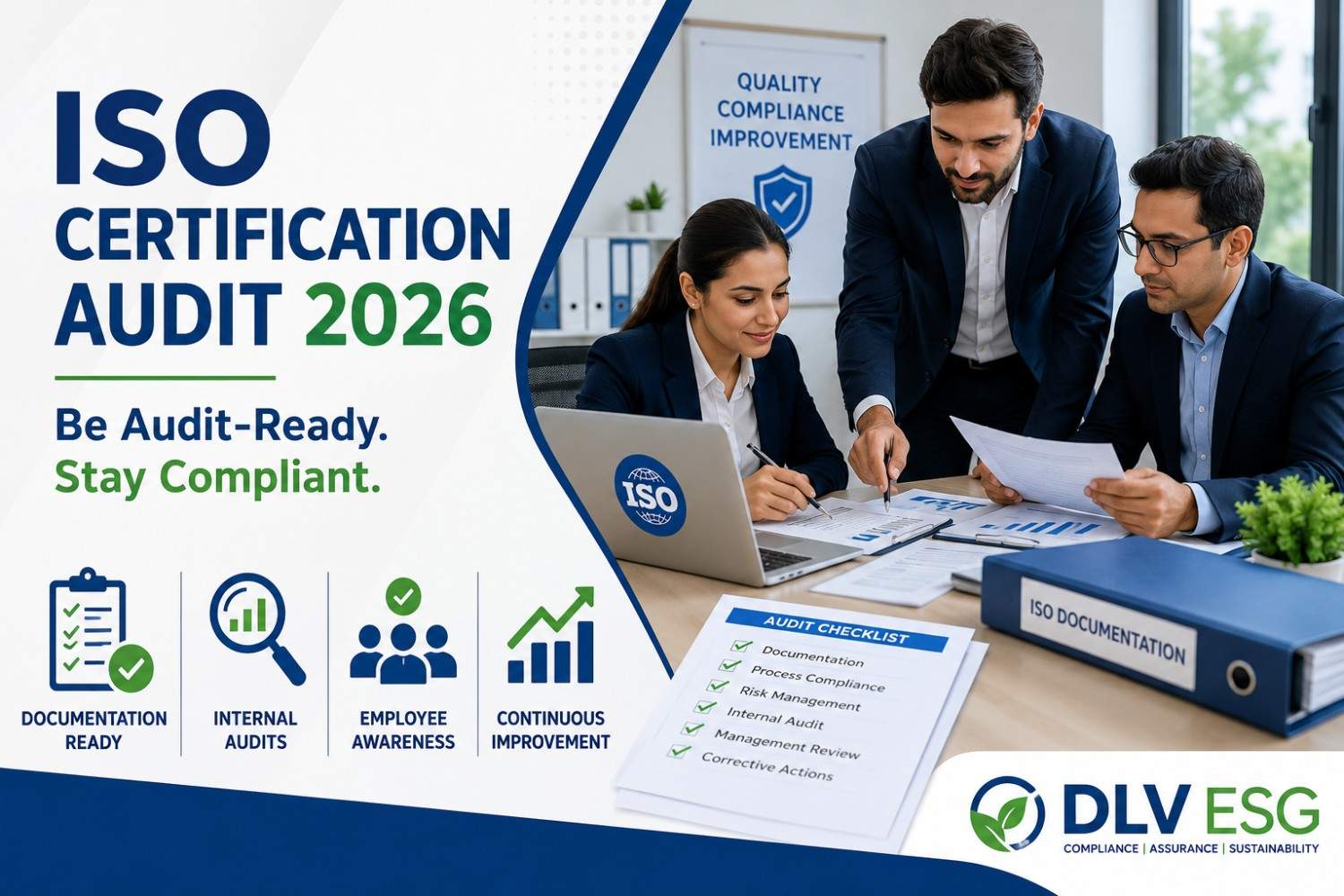
Business team preparing documents and compliance records for ISO Certification Audit 2026 with quality management and audit readiness concept.

To prepare for an ISO certification audit in 2026, run a gap analysis against your chosen standard, fix documentation and process gaps, train your team, and complete a mock audit before the official assessment. Plan for a 3–6 month timeline and account for new climate change requirements now built into ISO 9001 and ISO 14001.

ISO certification has shifted from a nice-to-have badge to a hard requirement for winning contracts, satisfying global buyers, and reassuring regulators. For Indian manufacturers, exporters, and MSMEs, a successful audit can unlock new markets—while a failed one can cost a major order.

The stakes are higher in 2026 because two of the most widely held standards are changing. ISO 14001:2026 was published on April 15, 2026, and ISO 9001:2026 is targeted for publication in September 2026. Both revisions formally fold in climate change considerations that first appeared as amendments in 2024.

This guide walks you through exactly how to prepare for an ISO certification audit in 2026. You'll learn what auditors expect, how the 2026 standard revisions affect your preparation, a step-by-step readiness plan, and how a consulting partner like DLV ESG Consulting Group LLP can shorten the path to certification.

What is an ISO certification audit and how does it work?

An ISO certification audit is a formal assessment by an accredited certification body to confirm your management system meets the requirements of a specific ISO standard—such as ISO 9001 for quality or ISO 14001 for environmental management.

The process usually happens in two stages. Stage 1 is a documentation review, where the auditor checks whether your policies, procedures, and records exist and align with the standard. Stage 2 is the on-site assessment, where the auditor verifies that your team actually follows those documented processes in daily operations.

If the auditor finds gaps, they raise nonconformities. Minor nonconformities can often be corrected within an agreed timeframe, while major ones may delay your certificate until resolved. Once you pass, certification is typically valid for three years, with annual surveillance audits in between.

According to a LinkedIn analysis of Indian manufacturing, over 80% of small and medium enterprises that adopted ISO 9001 reported higher operational efficiency—proof that the audit is a gateway to real business gains, not just a compliance checkbox.

What's changing in ISO standards for 2026?

The biggest preparation question for 2026 is whether the revised standards demand major rework. The short answer: no. Both ISO 9001:2026 and ISO 14001:2026 are evolutions, not overhauls. For ISO 14001, roughly 90–95% of the standard remains unchanged from the 2015 version, according to consultancy simpleQuE.

Still, you need to understand the targeted changes so your documentation and audit evidence reflect them.

What's new in ISO 9001:2026?

ISO 9001:2026 is targeted for publication in September 2026, with most of the additions sitting in the non-mandatory guidance sections rather than the core requirements. The confirmed changes from the Draft International Standard include:

  • Climate change in context (Clause 4.1): The 2024 amendment is now formally integrated, requiring you to consider climate change as a factor in your organization's context.
  • Stronger leadership duties (Clause 5.1.1): Top management must now promote and demonstrate a quality culture and ethical behavior.
  • Quality policy linked to strategy (Clause 5.2): Your quality policy must take into account the organization's context and support its strategic direction.
  • Clearer risk and opportunity management (Clause 6.1): This clause is reorganized into sub-clauses for readability, with expanded guidance in Annex A.
  • Expanded awareness (Clause 7.3): Employees must understand quality culture and ethical behavior.

What's new in ISO 14001:2026?

ISO 14001:2026 was published on April 15, 2026. The most notable update is explicit consideration of climate change. Key changes include:

  • Climate change made explicit (Clause 4.1): You must consider whether climate change is a relevant issue when determining your organization's context.
  • Interested parties and climate (Clause 4.2): You must determine whether stakeholders—regulators, customers, investors, communities—have climate-related requirements that affect your environmental management system.
  • Planning of changes (Clause 6.3): Change management is now a clearly stated requirement rather than scattered across clauses.
  • Externally provided processes (Clause 8.1): "Outsourced processes" is replaced with broader language covering suppliers, contractors, and service providers.
  • Defined audit objectives (Clause 9.2.2): Internal audit objectives must now be documented as part of audit planning.

Importantly, neither standard requires you to build a carbon strategy or measure emissions to comply. The requirement is to consider whether climate change is relevant to your system—not to act on it in a prescribed way.

Should you wait for the new standards before getting certified?

No. ISO 9001:2015 certificates remain valid until approximately September 2029, and the first ISO 9001:2026 certificates aren't expected before mid-2027, since certification bodies need 9–12 months to gain accreditation. Any work you do on a 2015-based system is a direct investment in your future 2026 certification, because the core requirements barely change. Choose to start now if winning contracts and improving operations matters more than waiting for a marginally newer standard.

How do you prepare for an ISO certification audit? A step-by-step plan

A structured approach turns audit preparation from a scramble into a predictable project. Here's the path most successful organizations follow.

Step 1: Choose the right standard and certification body

Confirm which standard your customers, regulators, or buyers actually require. A manufacturer chasing new contracts may need ISO 9001; an export unit under environmental scrutiny may need ISO 14001; a factory focused on worker safety may need ISO 45001. Then select an accredited certification body—in India, look for NABCB accreditation to ensure your certificate is recognized.

Step 2: Run a gap analysis

A gap analysis compares your current systems against every clause of the standard. This is the single most valuable preparation step because it shows exactly where you fall short before an auditor does. Document each gap, assign an owner, and set a deadline.

Step 3: Build and organize your documentation

Auditors check whether required policies, procedures, and records exist and are followed. Create the documented information the standard demands—quality or environmental policy, objectives, process records, and evidence of monitoring. For 2026 audits, make sure your context analysis (Clause 4.1) explicitly addresses climate change.

Step 4: Train your team

A common audit failure is staff who can't explain how the system works in practice. Run targeted workshops so employees understand the policy, their responsibilities, and—under the 2026 revisions—the organization's quality culture and ethical expectations.

Step 5: Conduct internal audits and a mock audit

Internal audits are mandatory under ISO standards, and for 2026 you should document clear audit objectives. A mock (pre-audit) run simulates the real assessment, surfacing nonconformities while you still have time to fix them cheaply.

Step 6: Complete management review

Top management must review the system's performance and confirm it remains suitable. For 2026, this review should confirm the system stays relevant in light of evolving conditions, including climate-related factors.

Step 7: Undergo the certification audit

With gaps closed, documentation in place, and your team prepared, you're ready for the Stage 1 and Stage 2 audits. Address any nonconformities promptly, and you'll earn your certificate.

What are the most common reasons ISO audits fail?

Knowing where others stumble helps you avoid the same traps. The most frequent causes of audit failure include:

  • Documentation that doesn't match reality. Procedures look perfect on paper, but staff follow different practices day to day.
  • Weak internal audits. Treating internal audits as a formality means real issues surface during the certification audit instead.
  • No defined audit objectives. Under ISO 14001:2026 Clause 9.2.2, vague audit planning is now an explicit gap.
  • Missing climate consideration. A context analysis that ignores climate change won't satisfy the 2026 revisions.
  • Untrained staff. Employees who can't explain the system signal that it isn't truly embedded.
  • Last-minute preparation. Rushing the process leaves no time to correct nonconformities before the official audit.

How long does ISO certification take, and what does it cost?

For most organizations, ISO certification takes 3 to 6 months. The exact timeline depends on your company size, the maturity of your existing systems, and how quickly documentation and training are completed. A structured gap analysis and pre-audit support can compress this considerably.

Costs vary based on company size, the number of standards involved, and your current readiness. Phased packages designed for MSMEs and startups make certification accessible even on tight budgets, so cost shouldn't be a reason to delay.

How can DLV ESG help you prepare for your 2026 ISO audit?

DLV ESG Consulting Group LLP is a Gurgaon-based ESG and ISO consulting firm that handles audit preparation end to end. The team has certified more than 500 businesses across 15+ ISO standards using a 100% NABCB-compliant process, with most clients reaching certification in 3 to 6 months.

DLV ESG serves manufacturers, exporters, MSMEs, textile units, FMCG companies, infrastructure firms, and healthcare organizations across India. The firm follows a clear, structured path:

  1. Free consultation – Discuss your goals, sector, and certification needs.
  2. Gap analysis – Identify where your current systems fall short of the standard.
  3. Documentation – Build required policies, records, and procedures using proven templates.
  4. Training – Prepare your team through targeted workshops.
  5. Pre-audit – Run a mock audit to catch issues before the official assessment.
  6. Certification – Complete the final audit and earn your certification.

Beyond ISO support, DLV ESG also helps with SEBI BRSR reporting, ESG strategy, Scope 1, 2, and 3 carbon accounting, social compliance audits like SMETA and SA 8000, and certified fire safety training—useful if your buyers or regulators ask for more than a single ISO certificate.

Choose DLV ESG if you want a partner that understands both Indian regulations and global buyer expectations, and one that builds practical, budget-aware solutions for small businesses as readily as for large enterprises.

Frequently asked questions about ISO certification audits in 2026

When should I start preparing for an ISO audit?

Start as early as possible—ideally 4 to 6 months before your target audit date. Teams typically need several months to complete a gap analysis, build documentation, train staff, and run a mock audit. Starting early gives you time to correct nonconformities before the official assessment.

Do the 2026 ISO revisions require me to redo my certification?

No. If you're certified to ISO 9001:2015 or ISO 14001:2015, your certificate stays valid through the transition period—around September 2029 for ISO 9001. You'll upgrade to the 2026 version at your next audit cycle within that window, not start over.

Start preparing for your 2026 ISO audit today

The 2026 standard revisions are manageable, but audit success still comes down to preparation: a thorough gap analysis, documentation that matches reality, a trained team, and a mock audit that catches problems early. Begin now, and you'll turn certification into a foundation for growth rather than a last-minute scramble.

Which ISO standard should my business start with?

It depends on your goals. Choose ISO 9001 if you need to standardize quality and win contracts; ISO 14001 if you face environmental scrutiny; ISO 45001 if worker safety is the priority; and ISO 50001 if cutting energy costs matters most. A consultant can help you match the standard to your sector and buyer requirements.

Can a consultant guarantee I'll pass the audit?

No ethical consultant guarantees a pass, because the certification body makes the final decision independently. What a consultant like DLV ESG does is dramatically improve your readiness through gap analysis, documentation, training, and a mock audit—reducing the risk of nonconformities at the official assessment.

What's the difference between Stage 1 and Stage 2 audits?

Stage 1 is a documentation review that checks whether your system is designed correctly on paper. Stage 2 is the on-site assessment that verifies your team actually follows those documented processes in practice. You must pass both to earn certification.

Do I need to measure my carbon footprint to pass a 2026 audit?

No. Both ISO 9001:2026 and ISO 14001:2026 only require you to consider whether climate change is relevant to your organization's context and stakeholders. They do not mandate measuring emissions or building a Net Zero plan—though many buyers and investors increasingly ask for that data separately.

8 thoughts on “How to Prepare for ISO Certification Audits in 2026

  1. rachin says:

    nice blog

  2. rajnish says:

    iso 9001

  3. surender sain says:

    Nice content

  4. Shubham says:

    Iso is important

  5. Tony says:

    Nice content

  6. Ak Rao says:

    Nice

  7. Ak Rao says:

    Nice content

Leave a Reply

Your email address will not be published. Required fields are marked *